| Home | Our Hope | |
| Bible Study |
|
July 30, 2017 |
| Alternative Sacrifice | ||
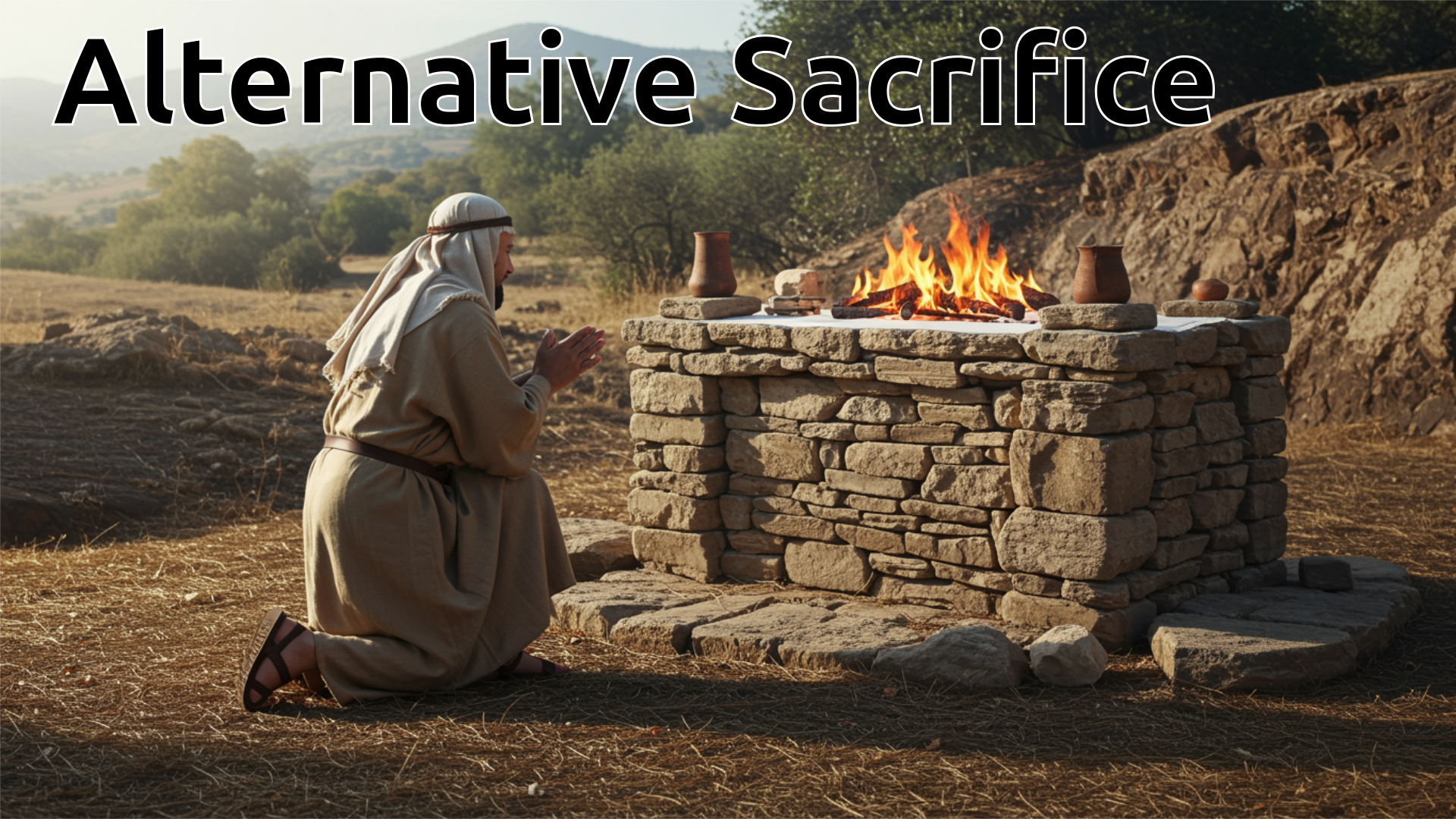
This is going to be a challenging study - one to make you think. It should result in a deeper understanding of God and his ways.
In this study we will look at the idea that God can specify whatever sacrifice he chooses to be the atonement for sin or to be for cleansing. We'll analyze some Old Testament verses where this seems to be happening.
In reading the Old Testament, we've become accustomed to certain ideas about the sacrifices.
Why were these sacrifices acceptable? Why weren't other sacrifices acceptable? The only answer is that God said they would be acceptable. There is nothing innate to a sacrificed lamb that keeps the angel of death from killing the firstborn sons. There is nothing innate to a sacrificed ram that it atones for unintentional sin. The only reason it is so is that God said it was so.
Those are examples from the Jewish sacrificial system. The sacrifices in the Old Testament all pointed toward a coming, perfect sacrifice. Therefore everything is tied together into a nice package by symbolism. It appears God chose those sacrifices for that reason.
Is there any reason God couldn't accept other sacrifices if he determined they would be acceptable? That's what we'll look at in this study.
This study was spawned by a study on 2 Samuel 11 and 2 Samuel 12. In those two chapters, David sins in many ways in his coveting of Bathsheba, adultery with Bathsheba, covering it up (lying), and the murder of Uriah. But just when he thinks he has covered it up, God exposes the truth. The penalty will be that the child born of that unholy union will die.
One message we can take from this is that sin has consequences on ourselves and on others.
"The child's death does, however, underscore an important truth; our sin affects not only ourselves, but also those around us. The long-reaching effect of a moment of sinful self-indulgence can be disastrous. We seldom pause to consider that factor in a moment of temptation. If we could see the results of our actions clearly, we'd say 'no' more often."1
Is that the only message though? With that death, God appears to have put the matter behind him, and David continues on in his relationship with God. Also, the marriage to Bathsheba is considered valid, which it wouldn't have been. This brings up the question: "Was that death of the child an atonement for David's sins?" This is not such a crazy idea. It turns out that many other people have asked this same question.
Also note that, if the death of the child is an atonement, it is atoning for an intentional sin. In the Jewish sacrificial system, there was no animal sacrifice that would do that. This may be foreshadowing the idea that atonement could be a man.
This is what God says, through Nathan, in pronouncing judgment.
"Why have you despised the word of the Lord by doing evil in His sight? […] 10 […] because you have despised Me […]" Then David said to Nathan, "I have sinned against the Lord." And Nathan said to David, "The Lord also has taken away your sin; you shall not die. 14 However, because by this deed you have given occasion to the enemies of the Lord to blaspheme, the child also that is born to you shall surely die." (2 Samuel 12:9-14)
This certainly seems like an odd form of atonement to those of us accustomed to the Jewish system. Instead of a freely given, personally sacrificed, unblemished animal, there is a forcibly taken, God-sacrificed (?), newborn human. Can that really be an atoning sacrifice? It's more like an atoning judgment.
Anything of value to you that you give up for God is a sacrifice. That can be praise from your lips, money, time, or other things. That doesn't mean it is an atoning sacrifice. In the end, the one who determines what kind of sacrifice atones for sin is God.
There are other examples where God has apparently accepted other things as atonement.
"Comfort, O comfort My people," says your God. 2 "Speak kindly to Jerusalem; And call out to her, that her warfare has ended, that her iniquity has been removed, that she has received of the Lord's hand double for all her sins." (Isaiah 40:1-2)
This prophecy from Isaiah was written before Israel went into the Babylonian captivity. It was given:
Israel was being sent into captivity because of her sins. It seems clear that Israel's "time served" is being counted as atonement for them. Notice the similarity of the words to David, "The Lord has taken away your sin," to those to Israel, "her iniquity has been removed."
This doesn't support the idea of Salvation by Works, of course. The Old Testament sacrifices were not a salvation by works system for the same reason. God had provided "sacrifices by faith" as a path to achieve atonement. Now Jesus is that path to atonement, which is also not a work, because it comes by faith.
So what can we take away from this? God has provided acceptable paths for everyone to atone for sin. He has also accepted other paths to atonement as special cases, as he chose. It is God who decides what is acceptable. Therefore, atonement is both an act of faith in God and obedience to him. There is no logical reason why the sacrifice of an animal or God-as-man should cover our own sins. By faith in God and in obedience to him, we accept his word that it will cover.
Having said that though, the Bible does specifically say that Jesus is now the only path. None-the-less there are many stories of God bringing people to that atonement via non-traditional means, such as visions and dreams, and not only through the preaching of his word.
God is just. We already know that. Whatever he chooses to do, he will be just.
Behold, he said also to Moses, "I shall show love on whomever I love, and I shall take pity on whomever I pity." 16 Therefore it is not by means of him who wills, neither by means of him who runs, but in the hand of God, the merciful. (Romans 9:14-15)
1 http://www.case-studies.com/david4