| Home | Our Hope | |
| Bible Study |
|
November 8, 2015 |
| The Prince To Come | ||
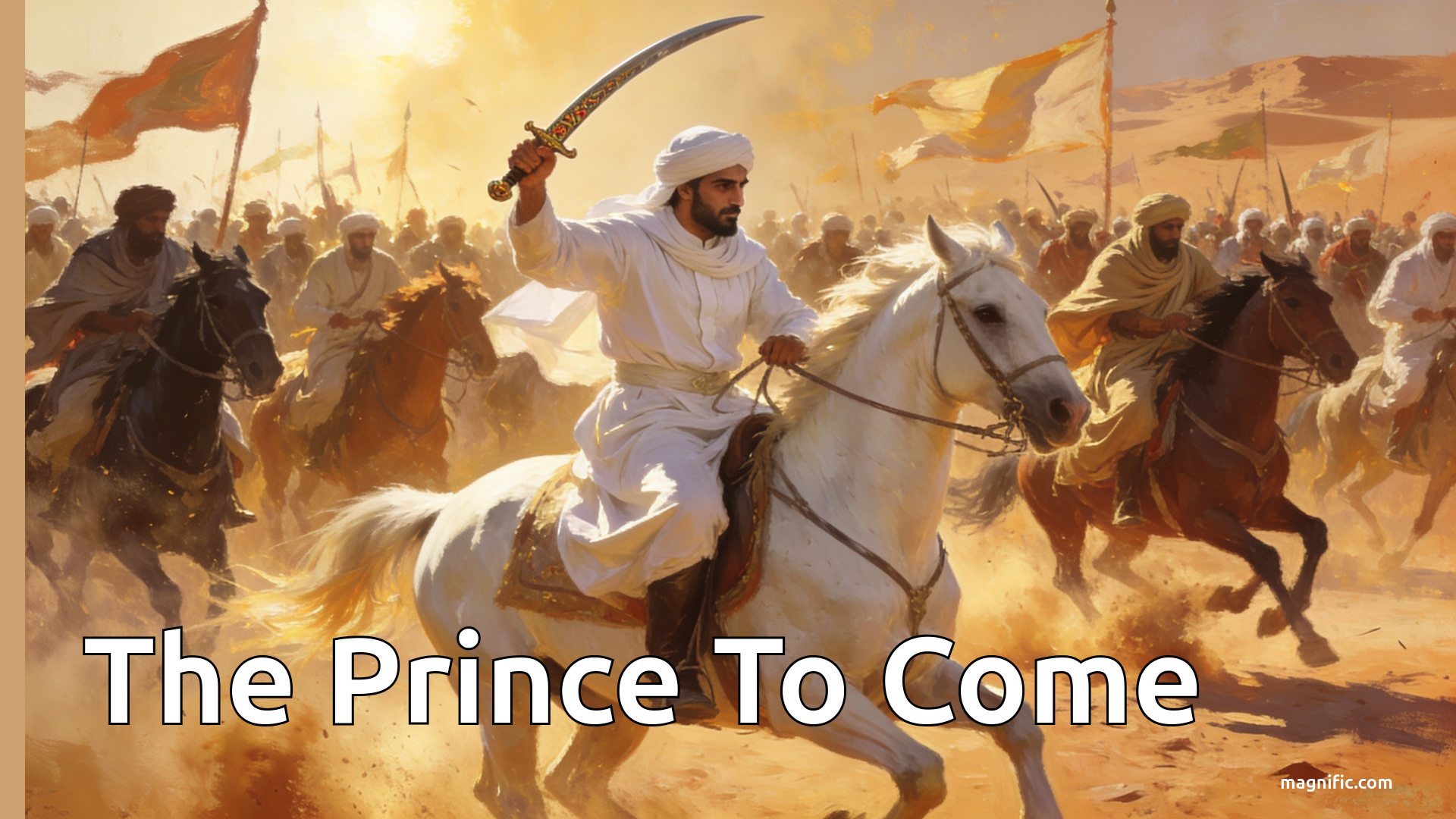
Since the time of Christ, Christians have wondered who the anti-Christ would be, and before them, the Jews also wondered. Our central verse for this study is one of the verses that gives some insight for the question.
The people of the [prince] who will come will destroy the city and the sanctuary (Daniel 9:26-27)1
At this point in the book of Daniel, the prophecy is talking about the death of the Messiah and the following destruction of the city of Jerusalem and the 2nd Temple.
We can learn something about the "prince to come" if we can understand who the "people of the prince" are. That would help us identify him when he appears.
Many people believe the "people of the prince" refers to the Romans, who destroyed the city and temple in 70 A.D. Therefore they believe the anti-Christ would be Roman. However, Rome collapsed before 500 A.D. So this viewpoint requires substitutes for Rome to carry on "Rome". One idea is that the Church of Rome (Roman Catholic) has carried on the name of Rome and, therefore the anti-Christ will come from it. Another idea is that Europe has continued in the style of Rome, and therefore they say this verse indicates the anti-Christ will come from it.
But for the past one thousand years, there has been a small minority who have been saying, you are looking in the wrong place. With recent world events and developments, more people are beginning to consider this "new" line of thinking.
This study presents that idea - that the "prince to come" will come from Arabs, and his one world government and one world religion will have Islamic roots. While not everyone agrees, Christians need to be aware of this possibility.
First, we need to clear up a misunderstanding in much of the church and the Western world. Even many non-believers know about the anti-Christ. Very few of these know that the New Testament describes two people, and each of these people is the leader of an organization.
Prophetic descriptions of organizations often appear as odd combinations of animals that it calls beasts. Generally each part of an animal describes a part of the character of an organization. These two organizations and their leaders are described in Revelation 13 as two beasts. The first comes out of the sea (unbelievers - I won't explain why in this study)2 and is led by a man who gets his power from Satan (the Dragon). Later on this man will be called the First Beast. The second beast comes out of the land (believers)3 and is led by a man who gets his power from the first beast. Later on this man will be called the False Prophet.
Daniel's "prince to come" is likely a reference to the First Beast. The word prince is sometimes used to indicate someone who thinks he is a king, but, at best, he is the king of nothing because God is the king of everything. For example, Satan is called the prince of the air or the prince of this world.
The book of Revelation does not use the word anti-Christ. In fact "anti-Christ" only appears in two books, 1 John and 2 John. In other books, he is called by other descriptive names like "man of sin". It's also important to understand that “anti-Christ” does not mean "against Christ". It means "false Christ" or "false Messiah," which tells us that he will represent himself as Messiah.
In summary then there will be two people, both leaders of significant organizations, one is a false Messiah and one a false Prophet.
At the start, I said that many people believe the “people of the prince” are Romans, and therefore the prince will be Roman. I mentioned one problem with that idea, but there are others.
How is it possible that the "prince to come" would not be a Roman? History records that the Roman army besieged and destroyed Jerusalem and burned the Temple while sacking it. A historian of that time, called Josephus, described it all. His account provides the answer.
Rome was a city that conquered the world. There simply were not enough fighting-age men in Rome to populate an army that could conquer and control a people and area of the size of the Roman Empire. The Roman army was populated by the people of many other nations. And these people were grouped together into military units by language and culture so that they could communicate and work together.
Josephus tells us that the military units that actually destroyed the city and temple were Syrian units and thus were most likely Arab people.
It's also important to understand that it was not the desire of the Romans to destroy the temple. The Romans were polytheistic, and one god was pretty much as good as another to them - though each man had his favorite. In fact, it was common to convert captured temples into temples for Roman Gods. Also, and very importantly, the Jerusalem temple was very beautiful and one of the wonders of the world.
Destroying the Temple was not among [the Roman commander, Caesar] Titus' goals, possibly due in large part to the massive expansions done by Herod the Great mere decades earlier.4
In fact, Josephus relates how the Roman leadership ordered the temple not to be burned, tried to stop the fire when the soldiers started it against orders, and were shocked at the frenzy with which the soldiers attacked the temple.
Then did Caesar, both by calling to the soldiers that were fighting, with a loud voice, and by giving a signal to them with his right hand, order them to quench the fire. […] But as for the legions that came running thither, neither any persuasions nor any threatenings could restrain their violence, but each one's own passion was his commander at this time. […] And now, since Caesar was no way able to restrain the enthusiastic fury of the soldiers, and the fire proceeded on more and more, he went into the holy place of the temple. […] Titus supposing what the fact was, that the house itself might yet be saved, he came in haste and endeavored to persuade the soldiers to quench the fire, and gave order to Liberalius the centurion, and one of those spearmen that were about him, to beat the soldiers that were refractory [stubborn, rebellious, and uncontrollable] with their staves, and to restrain them; yet were their passions too hard for the regards they had for Caesar, and the dread they had of him who forbade them, as was their hatred of the Jews, and a certain vehement inclination to fight them, too hard for them also […] And thus was the holy house burnt down, without Caesar's approbation5
Therefore the people who actually destroyed the temple and city were Arabs, of the lineage of Ishmael, the son of Abraham by his maidservant. They did it with such unrestrained zeal because hating the Jews has been common for as long as there have been Jews, which is especially true of Arabs. For this reason, it is possible for "the prince to come" to come from Arabs, not Romans.
At the time of the destruction of Jerusalem and the temple, the Arabs were polytheistic. About 600 years after Christ, a warrior called Muhammad appeared. We know he learned about Judaism and Christianity from travelers he met. Based on the teachings of an angel, he determined to convert his people from polytheism to monotheism. It became the religion we now know as Islam.
Salman Rushdie was one of the main people in modern times to alert the Western world to the danger of Islam with his book "Satanic Verses". But even as far back as the Protestant Reformation, writers were recognizing that Islamic end-times beliefs were a mirror of ours. It wasn't until 9/11 that most people started to look seriously at Islam to see if it fit the descriptions found in Bible prophecy.

Like Christianity and Judaism, Islam has "prophecies" and an eschatology or end-times belief system. But it is surprising to learn how one is the mirror of the other, and therefore they fit together like puzzle pieces. For example, the First Beast or anti-Christ in Judeo-Christianity is a villain. In Islam, a person with the same characteristics is described, but he is a hero.
Muhammad claimed that an angel had given him everything that became Islam. If Islam came only from the mind of Muhammad and his knowledge of the Old Testament and New Testament, why would he choose the evil people of the prophecies of Judeo-Christianity to be the heroes of his prophecies?
Islam introduces a third person as a significant player, but who is barely mentioned in the Bible. Again, it's odd that Muhammad would have such a deep understanding of the Bible that he would know of such an obscure character and choose him to be an important player. Therefore we have to wonder if there was another force involved.
It's also important to understand one difference between the two views. As Christians we understand that Jesus was the fulfilment of both a prophesied Messiah and a prophesied Prophet. The Jews, even now, are still expecting the fulfilment of these two to come as two separate people. The reason there are two people, a false Messiah and a false Prophet, instead of a combined false Messiah / Prophet in one (a false Jesus) has to be to deceive the Jews.
The main players in each eschatology are:
| Judeo-Christian | Islamic |
| Major Players | |
| Satan | |
| First Beast (the False Messiah) |
Al Mahdi (Imam Mahdi, the 12th Imam, or the Hidden Imam) |
| Second Beast (the False Prophet) | Isa |
| Minor Players | |
| False Shepherd | Dajjal |
|
Judeo-Christian |
Islamic |
|
First Beast (The False Messiah) - The Bible does not make clear who this person is or where he comes from. At one point he is called the Assyrian; at another point he is said to come from the people who destroyed the city and temple. The "Assyrian" may be a type, not a nationality, in the same way that John the Baptist was a type of Elijah. We know the First Beast more by what he will do and how he will act. |
Al Mahdi (Imam Mahdi, The 12th Imam, or The Hidden Imam) - Some Shia Muslims believe the Mahdi will be the return of the 12th Imam who was a real person living in the 9th century.6 Sunnis and some Shia do not accept this. Whoever he is he will be named after Muhammad and his father. And Al Mahdi will come from their line. As for Ishmael, I have heard you; behold, I will bless him, and will make him fruitful and will multiply him exceedingly. He shall become the father of twelve princes, and I will make him a great nation. (Genesis 17:20) |
|
Second Beast (The False Prophet) - The Bible is even less clear about the nature of this person. Again we know him more by what he will do and how he will act. He works to assist the False Messiah. Revelation 13 calls him the second Beast. His name is said to add to or count to 666.
|
Isa - This name is Jesus / Yeshua in Arabic. But Christians would not recognize this Jesus because he is Jesus as Muslims see him. They claim that Jesus never died, was not God, nor the son of God, and was only a prophet. This Jesus serves as the second-in-command to Al Mahdi
|
|
False Shepherd (Zechariah 11:16-17) - Very little in the Bible about this person. He is a deceiver of Israel. 16For I am going to raise up a shepherd over the land who will not care for the lost, or seek the young, or heal the injured, or feed the healthy, but will eat the meat of the choice sheep, tearing off their hooves. 17"Woe to the worthless shepherd, |
Dajjal - 'The Messiah Deceiver.' This is the evil against which Al Mahdi and Isa fight. Dajjal tries to lead people away from Allah, Al Mahdi, and Isa.
|
There is a strong correlation between the First Beast / False messiah (anti-Christ) and Al Mahdi. And there is a strong correlation between the Second Beast / False Prophet and Isa. The table below8 compares prophecies concerning the False Messiah (anti-Christ) and Al Mahdi.
|
False Messiah (Judeo-Christian) |
Al Mahdi (Islamic) |
|
Will be the head of a one-world government |
Will be the head of a one-world government |
|
Leads a one world religion |
Sets up Islam as a one-world religion |
|
Confirms a 7-year treaty between the Jews and the Gentile world |
Upholds a 7-year treaty between the Jews and the Gentile world |
|
Rules for approximately 7 years |
Rules for approximately 7 years |
|
The Bible describes a white horseman of the Apocalypse |
Muslim scholars see this as evidence of the Mahdi in the Christian Bible |
|
Invades / conquers Israel and Jerusalem |
Invades / conquers Israel and Jerusalem |
|
Rules from Jerusalem |
Rules from Jerusalem |
|
Targets and persecutes Christians and Jews who do not convert |
Focuses his conversion efforts on Jews and Christians and kills those who do not convert |
|
Changes the laws and the calendar |
Implements Sharia Law and the use of the Islamic calendar |
|
Assisted by the false prophet |
Assisted by Isa |
|
Granted supernatural powers from Satan to perform signs and wonders |
Granted supernatural powers from Allah to perform signs and wonders |
|
Arrives on the scene during a period of great turmoil caused by war, crime, natural disasters, and religious apostasy |
Arrives on the scene during a period of great turmoil caused by war, crime, natural disasters, and religious apostasy |
If indeed Al Mahdi is the False Messiah, here is the situation in the time of Al Mahdi as told by Islamic hadiths. The world will be dispirited and in turmoil. Out of the chaos will come a leader. At first his authority is small, but he soon becomes powerful. His philosophy of peace is well-received, and he becomes known as a peace broker (Islam means Peace). He establishes a 7-year peace agreement between Israel and either the world or just the Muslim world. At some point he begins to display supernatural powers. He finds the Ark of the Covenant and some ancient Jewish and Christian documents, which he uses to show that modern Judaism and Christianity are distortions of the truth they once held9. By now he is essentially the leader of the world. With Judaism and Christianity discredited, he commands that everyone convert to his religion (Islam?) or be killed.
With a man of such skill and power and with such a threat to life, it's easy to see that most people would convert to his religion. It would also be no surprise to find that many weak and uninformed Christians would also convert.
Should we care that Islamic prophecy is so close to God's word? Should we trust it?
We know that Muhammad read the Bible, both the Old Testament and New Testament; wasn't he using only what he saw there? It would be strange for Muhammad to claim to be a prophet of the God of the Bible and to take the evil characters from the Bible and call them the great characters of Islam, but I suppose it could be done. Muhammad doesn't copy from the Bible though. He adds new information that fills in gaps in Bible prophecy. Did he just pick that out of thin air?
There is reason to believe he had help. We mentioned Salman Rushdie's book, "Satanic Verses". The title comes from an incident that happened early in Islam.
One day, the Prophet Muhammad was sitting with a small group of believers and a larger group of polytheists from his own tribe, the Quraysh. At this time, tensions seemed to be running particularly high between Muhammad and the Quraysh. Muhammad was praying aloud to this group and reciting the fifty-third surah of the Qur'an, The Star.
When he reached the twentieth verse of this sura, which contains a condemnation of Allat, al-'Uzza, and Manat, the three deities worshipped by the Quraysh, two verses were added to his recitation by Satanic suggestion. "Those high gharānīq [deities]! Indeed their intercession is to be hoped for!" (60).
This approbation of the ancestral religion of the Quraysh won their approval and confused the believers. The narratives disagree about the details of what happened afterwards, but eventually Muhammad became aware of the calamity that had happened - he had recited Satan's words alongside those of God - and was aghast.10
Islam currently claims that Muhammad is infallible, and therefore this story is said to be false. The story is certainly true though. It comes from many separate authors and from earliest times.
We have solid reason, though, to believe that Muhammad was getting at least some help from Satan. This could include the extra information that we find in Islamic prophecy. We can't forget, though, that Satan is a lying deceiver and could be providing this information to achieve other goals.
Later, Allah told Muhammad that it was ok that he spoke the words of Satan. That happens to prophets sometimes.
It is important for Christians to know what the Bible says about the great deceivers to come and the various interpretations of those passages. There are important warnings that will keep us from being fooled by the False Prophet and anti-Christ.
We've seen in this study that there are good reasons to believe the anti-Christ will come from Syria / Assyria and from Islam.
But it is also important not to "believe" in any one interpretation of the scriptures to the exclusion of all others. Instead Christians should be informed and watchful.
1 NIV, which translates to "ruler" what other versions translate as "prince"
2 3 Stan Burton, Where The Sea Leads
4 http://en.wikipedia.org/wiki/Siege_of_Jerusalem_(70)
5 Josephus, Wars of the Jews, book VI http://www.gutenberg.org/files/2850/2850-h/book6.htm
6 http://en.wikipedia.org/wiki/Muhammad_al-Mahdi
7 http://www.abovetopsecret.com/forum/thread423757/pg1
8 http://www.abovetopsecret.com/forum/thread423757/pg1
9 Joel Richardson, The Islamic anti-Christ: The Shocking Truth about the Real Nature of the Beast
10 Elias Saba, Truth Making in Early Islam https://laviedesidees.fr/Truth-Making-in-Early-Islam