
| Home | Our Hope | |
| Bible Study |
|
February 17, 2013 |
| Return of the King | ||
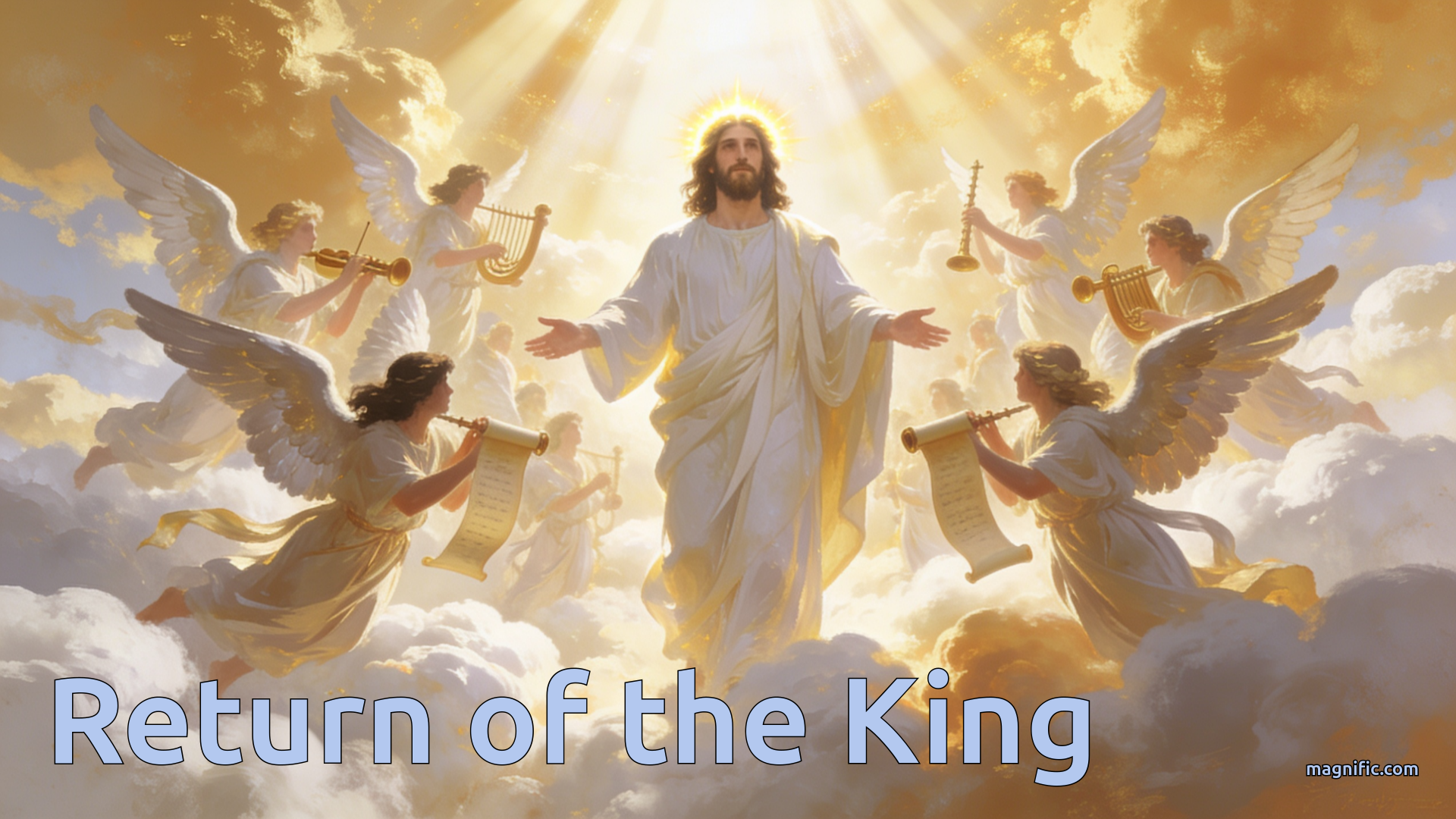
The return of our Lord and Savior is a central theme in the New Testament books. Jesus spoke about it, angels talked about it, Paul preached and wrote about it, and other apostles did as well. This promise of a returning king and a resurrection was a source of hope to the early Christian church as it was persecuted and its people were killed.
Of all the letters that Paul wrote, the two written to the Thessalonians are most focused on the return of the king, which is also called the Second Coming or the Day of the Lord. In those letters it is a theme that he returns to time and again. In this study we will pull out the parts of those two letters that cover the return of the king and examine them.
The church of Thessalonica was under severe persecution. Paul refers to it in 1 Thessalonians 3 when he says that he is writing to them, "3 Lest any of you should lose hope by such sufferings, for you are aware that we are appointed to this. 4 For also when we were with you, we said to you before that we would be persecuted, just as you know it happened." And later in 2nd Thessalonians Paul refers to people of the Thessalonian church who have died - though we don't know why they died.
Paul's intent here is to use the Second Coming as a source of encouragement. We know that the Second Coming was an important part of the teaching that Paul did when starting any church. So what he says here would not have been new to them and would only have been a reminder of why they risk their lives.
The book of 1st Thessalonians has an interesting structure. The first three chapters each end with a small reference to the Second Coming as though they are hints of what is to come. Then, in the middle of the 4th chapter, Paul plows into the topic and continues on through the middle of chapter 5. Here are the verses from 1st Thessalonians.
While you await his Son from Heaven, Yeshua, him whom he raised from among the dead; He is the one who delivers us from the fury that is coming. (1 Thessalonians 1:10)
This little hint reminds the reader that Jesus is coming, and when he comes, he will deliver his people from the fury that is coming upon those who remain.
Then in Chapter 2 we see this:
For what is our hope and our joy and the crown of our glory, but you alone, before our Lord Yeshua at his coming? (1 Thessalonians 2:19)
In this little hint Paul is telling the Thessalonians how important it is to him and his coworkers that the Thessalonians be ready for the Second Coming.
Then in Chapter 3 we see this:
And establish your hearts without a fault in holiness before God Our Father at the arrival of our Lord Yeshua the Messiah with all of his holy ones. (1 Thessalonians 3:13)
This hint tells the Thessalonians how important it is for them that they be ready for the Second Coming.
These hints cover different aspects of the Second Coming.
These hints boil down to waiting and being ready.
Next we come to chapter 4, where Paul gets into details about the Second Coming.
I want you to know my brethren, that you should not have sorrow in you for those who are asleep, as do the rest of mankind who have no hope. 14 For if we believe that Yeshua died and arose, in this way also God shall bring with him those who have fallen asleep in Yeshua. 15 But this we say to you by the word of our Lord, that we, those who remain at the coming of our Lord, we who have life, shall not overtake those who are asleep; 16 Because our Lord shall descend from Heaven with a command and with the voice of the Archangel and with the trumpet blast of God, and the dead who are in the Messiah shall rise first; 17 And then we who remain, who have life, we shall be carried away with them together in clouds to a meeting of our Lord in the air, and in this way, we shall always be with our Lord. 18 Therefore, comfort one another with these words. (1 Thessalonians 4:13-17)
Paul doesn't say it directly, but I think the reason this mention of death is included in 1st Thessalonians is that some of the people in the church have died from the persecution they have received. These would have been innocent people who were murdered for their faith. Along with the usual sadness there would be for the loss of someone, there would also be the unfairness of it.
The church wants to believe, "He means that Christians shouldn't have as much sorrow as unbelievers," but that isn't what he says. Watch what happens when I pull one clause out of verse 13.
I want you to know my brethren, that you should not have sorrow in you about those who are asleep, [because you have] hope. (1 Thessalonians 4:13)
He means Christians shouldn't have sorrow, period. There is no "as much as" statement in there, and no "you should not have such deep sorrow. He means what he says, "because you have a hope, you should not sorrow.
In those days, some people would go on long journeys, where they might be gone for many months, perhaps more than a year. This was normal life for the apostles. When people left like this, the family would have no idea when they would come back or even if they would. There were no communications as we have now. If the person never came back, the family might never know what happened. They didn't have cameras or ways to preserve dead bodies.
So when a person left on a trip like that, it was a sad and concerning separation, sad that you won't see them for a long time, concern about where they are and how they are doing. That's to be expected, and also expected by living Christians at that time, when a brother or sister in the faith has died. But there is no cause for sorrow.
Also note what Paul says a few verses later.
Therefore, comfort one another with these words, [that you will see them again in the resurrection]. (1 Thessalonians 4:18)
Christians should find comfort in those words, but they sorrow like unbelievers.
Also in these verses, Paul describes the order in which things will occur. The Second Coming event will begin with our Lord descending from Heaven and giving a command with the voice of an Archangel and with a trumpet blast from God. Then the dead believers will be raised to life. Then we, along with them, will be carried up into the clouds to meet with Jesus. From then on we will always be with him.
Again we see how Paul is using this message of the Messiah's return and the resurrection of believers as a source of comfort for them in their suffering.
But you do not need to be written to about times and seasons, my brethren, 2 For you truly know that the day of our Lord so comes as a thief in the night. 3 When they shall say, "There is peace and quiet", then suddenly destruction shall arise upon them as labor pains upon a pregnant woman, and they shall not escape. (1 Thessalonians 5:1-3)
4 But you, my brethren, you are not in darkness that the day should overtake you as a thief. 5 For you are all children of light and children of the day and you are not children of the night, neither children of darkness. 6 Let us not sleep therefore as the rest, but let us be watchful and sensible. 7 For those who sleep, sleep at night, and those who are drunk are drunk at night. 8 But we are the children of the day; let us be vigilant in our minds and put on the breastplate of faith and of love and let us take the helmet of the hope of Life, 9 Because God has not appointed us to wrath, but to the possession of Life in our Lord Yeshua the Messiah, 10 He who died for our sake, that whether we are awake or asleep, we shall live together with him. (1 Thessalonians 5:4-10)
11 Because of this, comfort one another and build one another up just as you have done. (1 Thessalonians 5:11)
Paul reminds them that he has already talked to them about this event. This event will come when the unbelievers do not expect it. In fact just when the unbelievers think that everything is under control and going to be peaceful and quiet, then things will quickly become very bad.
The metaphor used here, and in other places in the Bible, is that of a pregnant woman giving birth. At first the contraction pains are short and infrequent, but quickly they escalate and become stronger and longer until the birth is complete.
Having talked about how this event will come as a surprise to unbelievers, Paul now says that this day will not come as a surprise to believers. As children who live in the light we can see the event coming. But those who live in darkness will not. They will continue on in their own false wisdom.
Then Paul says that we should not sleep or be drunk like those who live in darkness. But Paul is using "darkness" as a symbol for lack of understanding. Therefore we need to understand sleep and drunkenness in the same way. By "sleep," he means becoming inactive or unproductive in the faith. By "drunken," he means being spiritually confused by false teaching. Instead of doing these, he says that we should be watchful and prepared, strong in faith and hope and life. This takes us back to the hints, which were about waiting and being ready.
Now Paul says something very important. Earlier he talked about the Thessalonians and all Christians being appointed to persecution. But he says now that we are not appointed to wrath. Whose wrath? The wrath1 of God that will fall on the unbelievers after the Second Coming.
At the end of this section he again closes with the idea that they should comfort one another with this knowledge.
The book of 2nd Thessalonians is only three chapters long, and the third chapter is dedicated to closing remarks. The first two chapters spend a lot of time discussing the Second Coming.
And truly it is just before God to reward suffering to your tormentors, 7 And you who are tormented he shall save with us by the revelation of our Lord Yeshua the Messiah who is from Heaven, with the armies of his Angels, 8 whenever he executes vengeance in blazing fire on those who do not know God and on those who have not recognized the good news of our Lord Yeshua the Messiah,(2 Thessalonians 1:6-8)
9 For they will be paid in judgment: eternal destruction from the face of our Lord and from the glory of his power, 10 whenever he comes to be glorified in his holy ones, he will show his wonders in his believers, because you believed in our testimony that was for you in that day. (2 Thessalonians 1:9-10)
Paul says: When Jesus returns with his armies of angels, he will save us from our tormentors. But he is a just God, and justice requires vengeance. In time he will reward those who have persecuted his people. Their reward will be suffering, the Lake of Fire2 and complete separation from our Lord and his glory.
Paul is drawing a contrast. Those who persecuted God's people will be rewarded with suffering, and those who suffered persecution will be rescued.
In Chapter 2, Paul gives the Thessalonians a warning about false ideas in their time, but he fills it with prophecy that has still not come true in our time.
But we beg of you, my brethren, concerning the arrival of our Lord Yeshua the Messiah and concerning our assembling unto him, 2 that you would not be soon shaken in your minds, neither be troubled, either from word, nor from a spirit, neither from an epistle that is as if from us, namely, that, "Behold, the day of our Lord has arrived." 3 Let no man deceive you by any means, to the effect that surely no revolt will first come and the man of sin, the son of destruction, be revealed, 4 He who opposes and exalts himself against everything that is called God and religion, just as he will sit in the Temple of God, as God, and will show concerning himself as if he is God. (2 Thessalonians 2:1-4)
5 Do you not remember that when I was with you, I said these things to you? 6 And now you know what controls, that he may be revealed in his time. 7 The mystery of evil has even now begun to work within, only if that which now controls will be taken from the midst; 8 and then that Evil One will be revealed, whom our Lord Yeshua will consume with a breath of his mouth, and will destroy him by the revelation of his coming. 9 For the coming of that one is in the activity of Satan in all power, signs and false wonders, 10 and in all the error of evil which is in the perishing, because they did not receive the love of the truth in which they would have Life. 11 Because of this, God sent them the activity of delusion that they would believe lies. 12 And all those who believed not the truth, but chose evil, will be judged. (2 Thessalonians 2:5-12)
There were many false teachers in Paul's time, just as there are now. In fact some of them are teaching the same false ideas now that they taught 2000 years ago when their teachings were refuted by Paul. It appears that there was a false teaching going around that Paul wanted to squash - a teaching that the Second Coming has already arrived.
Paul doesn't want them to be shaken or troubled if they hear this, even if it seems to be coming from a believable source. If such a report were true, it would be very troubling. It would mean that everyone left on the earth would have been unacceptable to our Lord and would not be with him in his glory.
He gives them an event to watch for that will precede the Second Coming. There will be a revolt, says Paul, a revolt against the faith. Other translations use the words "falling away." Coincident with that, the anti-Christ will be revealed. This person will be revealed by his actions. He will set himself up as an authority that opposes God and all religion. He will sit in the temple of God, representing himself as if he is God.
Paul says that he told the Thessalonians what controls the time when the anti-Christ appears. When this control is removed, then the anti-Christ will be revealed. However we weren't there when Paul told the Thessalonians, and he doesn't tell us here what the control is, so there has been much speculation on what or even who is removed and from where.
This control keeps Satan from acting. The only being that can do that is God, and the only being that can be removed from us that is God is the Holy Spirit. Therefore Paul is saying a time will come when the Holy Spirit will be removed (or made inactive) so that Satan can bring on the anti-Christ. Therefore it is hardly a surprise that there would be a revolt within the faith.
The coming of the anti-Christ will be done in the way Satan works, false power, false signs, false wonders, and deceitful teaching. Because they do not love the truth, God will give them a strong delusion so that they will believe lies, which will cause them to perish.
1 See Bowls of Wrath, Revelation 16
2 Revelation 20